Firearm Suicide Is Rising Among Women, With The Largest Increase Among Black Women
By Penny Okamoto, COEF
September is Suicide Prevention Awareness Month. COEF remembers those we have lost, supports people who are struggling, and strengthens our commitment to preventing suicide.
Firearms have become the leading method of suicide among women in the United States. In 2023, firearms accounted for 35% of female suicide deaths, compared with 29.6% involving poisoning and 25.9% involving suffocation. (National Institute of Mental Health)
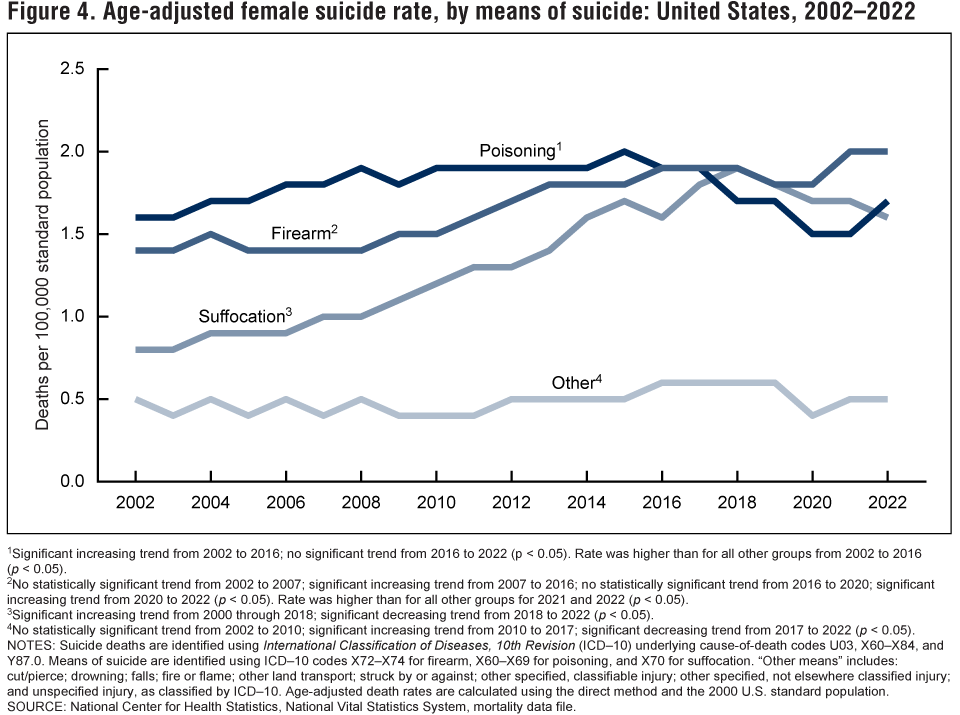
Figure 4. Age-adjusted female suicide rate, by means of suicide: United States, 2002–2022.
Source: National Center for Health Statistics, National Vital Statistics System, mortality data file. From Garnett MF, Curtin SC. Suicide Mortality in the United States, 2002–2022. NCHS Data Brief No. 509, September 2024.
The CDC reports that the female firearm-suicide rate increased from 1.4 deaths per 100,000 in 2007 to 2.0 in 2022, and that firearms were the leading means of suicide among females in 2022.
The similar death rates for firearms, poisoning, and suffocation among women mask enormous differences in how frequently these methods are attempted and how often an attempt is fatal. Poisoning is used in far more nonfatal attempts, while firearms are far more lethal. Thus, a relatively smaller number of firearm attempts can produce a number of deaths comparable to much more frequent poisoning attempts.
The Burden and Trajectory Differ Across Racial and Ethnic Communities
The burden and trajectory of suicide are not the same across racial and ethnic communities. American Indian/Alaska Native women have the highest overall suicide rate among women, followed by White women. Yet the most dramatic recent increase in firearm suicide has occurred among Black women: their firearm-suicide rate increased 169% from 2015 to 2024, compared with increases of 57% among Hispanic/Latina females and 51% among Asian/Pacific Islander females. The firearm-suicide rate increased 4% among White females and declined 19% among American Indian/Alaska Native females. (Johns Hopkins Public Health)
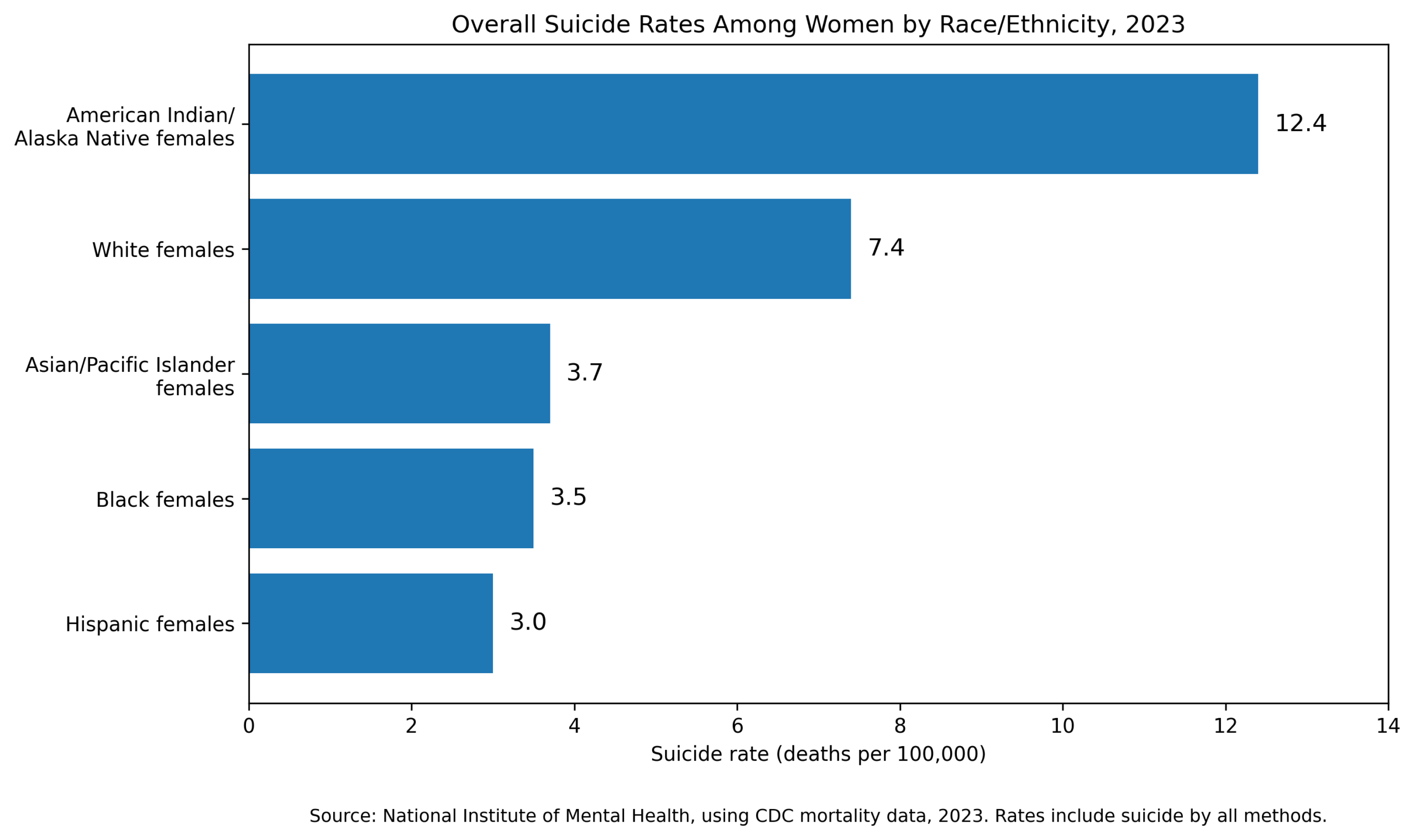
Overall suicide includes all methods (poison, hanging, falls, etc.); firearm-suicide rates include only deaths involving firearms. A population can have a lower overall suicide rate while experiencing a rapid increase in firearm suicide. Understanding both the existing burden and the changing pattern is essential to effective prevention.

Two measures tell two different stories
The most recent national figures reported by the National Institute of Mental Health, using CDC data from 2023, show that American Indian/Alaska Native women had the highest overall suicide rate among women, at 12.4 deaths per 100,000. White women had the second-highest rate, at 7.4 per 100,000. The rates were 3.7 among Asian/Pacific Islander women, 3.5 among Black women, and 3.0 among Hispanic women. (National Institute of Mental Health)
The latest Johns Hopkins Center for Gun Violence Solutions analysis of CDC mortality data tells a different story when we look specifically at firearm suicide. In 2024, White women had the highest firearm-suicide rate among these groups, at 2.64 per 100,000, followed by American Indian/Alaska Native women at 2.03, Black women at 1.40, Hispanic/Latina women at 0.85, and Asian/Pacific Islander women at 0.62. (Johns Hopkins Public Health)
This distinction is critical. AI/AN women have the highest overall suicide rate among women, while White women have the second-highest overall rate. But among firearm suicides in 2024, White women had the highest rate, followed by AI/AN women. Meanwhile, Black women had a substantially lower firearm-suicide rate than White and AI/AN women, but experienced by far the largest percentage increase in firearm suicide between 2015 and 2024. (Johns Hopkins Public Health)
Firearm ownership is changing
A 2026 analysis of the 2024 National Firearms Survey estimated that 29.8 million adults acquired firearms between 2021 and 2024, including 11.2 million adults who became new firearm owners. Women accounted for 46.3% of new firearm owners, and 46.1% of new owners were Hispanic and/or people of color. The researchers also estimated that 6.6 million children were newly exposed to household firearms because an adult acquired a firearm in a household that previously did not have one. (PubMed)
These findings are particularly important when considered alongside the changing pattern of firearm suicide.
They raise an important question:
What, if anything, is the relationship between increasing firearm acquisition among women and increasing firearm suicide among some groups of women of color?
There is no direct evidence showing that Black women who purchased firearms were subsequently the women who used those firearms to die by suicide. A firearm acquired by one person may be used by that person, by another household member, or by no one in a suicide. The available national data do not allow researchers to make those connections at the individual level.
But uncertainty about that relationship is not a reason to ignore it.
A firearm brought into a home can become accessible to anyone who has access to that firearm. From a public-health perspective, the relevant issue is therefore not simply who purchased the firearm, but who can access it—particularly during a period of crisis.
Firearm acquisition increased substantially among women and racial and ethnic minorities during the early 2020s
Research shows that firearm acquisition increased substantially among women and racial and ethnic minorities during the early 2020s. A 2026 study using California administrative records found large increases in first-time handgun acquisition among women in every racial and ethnic group examined. Asian women experienced an estimated 1,200% increase in the first month of the pandemic, while first-time acquisition among Black and Hispanic women increased by approximately 600% at the pandemic’s onset. Over the first 19 months of the pandemic, women and racial and ethnic minorities continued to have larger relative increases in first-time handgun acquisition than men and White adults. Black women experienced the largest cumulative relative increase, with approximately 14,000 becoming first-time handgun owners—a 350% increase compared with their pre-pandemic rate.
The available studies do not provide comparable estimates for American Indian/Alaska Native women, so we cannot conclude from this research that firearm acquisition increased among AI/AN women to the same degree.
An important consideration when interpreting these percentages is that the groups with the largest percentage increases in firearm acquisition generally had lower firearm ownership rates to begin with. The California researchers explicitly found an inverse relationship between pre-pandemic handgun ownership and the size of the pandemic spike. Thus, the 350% increase among Black women does not mean that 350% more Black women than White women bought guns. It means that the increase was much larger relative to Black women’s much smaller baseline rate of handgun ownership.
The striking increase among Black women
Between 2015 and 2024, the firearm-suicide rate among Black women increased from 0.52 to 1.40 deaths per 100,000—a 169% increase. Johns Hopkins reports that this was the largest relative increase among female racial and ethnic groups during that period. (Johns Hopkins Public Health)
This does not mean that Black women have the highest overall suicide rate. They do not. In 2023, the overall suicide rate among Black females was 3.5 per 100,000, compared with 12.4 among AI/AN females and 7.4 among White females. (National Institute of Mental Health)
What the Black women’s data tell us is something different: firearm suicide is increasing unusually rapidly within this population.
Research on Black firearm owners has found significantly more reported suicidal ideation among Black firearm owners than among Black adults who did not own firearms. That study does not establish that firearm ownership caused suicidal ideation, but the finding points to a population and a set of questions that warrant further research.
Other research involving Black adults has found associations between exposure to gun violence and suicidal ideation. Together, these studies suggest that firearm ownership, firearm access, exposure to violence, perceptions of safety and threat, and experiences of trauma may intersect in complicated ways.
American Indian and Alaska Native women
The picture for American Indian and Alaska Native women is different.
AI/AN women had the highest overall suicide rate among women in 2023—12.4 per 100,000, according to NIMH and CDC data. (National Institute of Mental Health)
Their firearm-suicide rate was also high in 2024 at 2.03 per 100,000, second only to White women in the groups shown. But unlike Black, Hispanic/Latina, and Asian/Pacific Islander women, the AI/AN female firearm-suicide rate declined 19% between 2015 and 2024. (Johns Hopkins Public Health)
These statistics illustrate why both current rates and changes over time matter.
AI/AN women continue to face an exceptionally high overall suicide burden, while Black women are experiencing a particularly rapid increase in firearm suicide. These are different public-health concerns, and neither should obscure the other.
Firearm access matters—even when the owner isn’t the person at risk
This is why conversations about firearm storage are so important.
A recent national study of U.S. firearm owners found that 52.5% of respondents said they intended to keep at least one firearm unlocked regardless of life circumstances. Yet among respondents who said they were willing to change their storage practices, 97.3% identified the presence of a child and 97.2% identified a household mental or physical health concern as circumstances that would influence their storage decisions. (Nature)
Those findings are concerning—but there is also an opportunity for prevention.
They suggest that many firearm owners recognize that circumstances can change. A child may visit. Someone may move into the home. Someone may become seriously ill. A family member may experience depression, substance use, suicidal thoughts, or another crisis.
We cannot always predict when circumstances will change.
Safe storage should already be your routine.
Every firearm should be stored locked and unloaded, with ammunition secured separately and firearms inaccessible to anyone who should not have access to them.
Safe storage is a way to reduce the possibility that a temporary crisis becomes a permanent loss.
Sources & Further Reading
National Institute of Mental Health — Suicide
Current NIMH presentation of CDC suicide data, including overall suicide rates by sex and race/ethnicity and suicide deaths by method. (National Institute of Mental Health)
Johns Hopkins Center for Gun Violence Solutions — Annual Gun Violence Data 2024
Latest national firearm mortality data, including firearm-suicide rates and changes by race, ethnicity, and sex. (Johns Hopkins Public Health)
Miller M, Fischer S, Azrael D. “Firearm Acquisition and New Exposure to Household Firearms After the Initial Pandemic Purchasing Surge: Results From the 2024 National Firearms Survey.” Annals of Internal Medicine, 2026.
Estimates firearm acquisition from 2021–2024, including new firearm owners, women, people of color, and newly exposed household members and children. (PubMed)
Beatty AE, Richardson JS, Hotle K, et al. “Barriers, motivators, and alternative safety strategies associated with firearm storage decisions among U.S. firearm owners.” Scientific Reports, 2026.
Examines firearm-storage practices and circumstances that motivate changes in storage. (Nature)
Hoover C, Xu Y, Lanphear B, et al. “Firearms, storage practices, and child blood lead levels and household dust lead loadings: findings from the HOME study.” Journal of Exposure Science & Environmental Epidemiology, 2026.
Examines firearm storage, household dust lead, and children’s blood lead levels. (Nature)
Hoover C, Specht AJ, Hemenway D. “Firearm licensure, lead levels and suicides in Massachusetts.” Preventive Medicine, 2023.
Examines firearm licensure, lead exposure, and suicide across Massachusetts municipalities. (PubMed)